ABAP Exception Handling Deep Dive: Building a Resilient, Layered Error Management Architecture in SAP S/4HANA
If you’ve spent any real time debugging production issues in SAP systems, you already know this truth: exception handling is not a feature—it’s architecture. The difference between a system that recovers gracefully and one that dumps cryptic short dumps on end users almost always comes down to how thoughtfully the error handling layer was designed from day one. In this guide, we’re going beyond the basics of ABAP exception handling to explore how you build a robust, layered, and maintainable error management strategy inside SAP S/4HANA—one that scales with your application and actually helps operations teams diagnose problems fast.
This isn’t about memorizing syntax. It’s about making architecture-level decisions you’ll be proud of six months into production.
Why Most ABAP Error Handling Falls Short
Let me be direct about what I see in the field. The majority of ABAP codebases I’ve reviewed fall into one of three anti-patterns:
- The Black Hole:
CATCH cx_root INTO lx_exc. WRITE lx_exc->get_text( ).— caught, logged nowhere, silently swallowed. - The Fire Alarm: Every trivial exception triggers a full program termination or a dialog box that freezes a background job.
- The Denial: No exception handling at all, with the assumption that SAP’s runtime will figure it out.
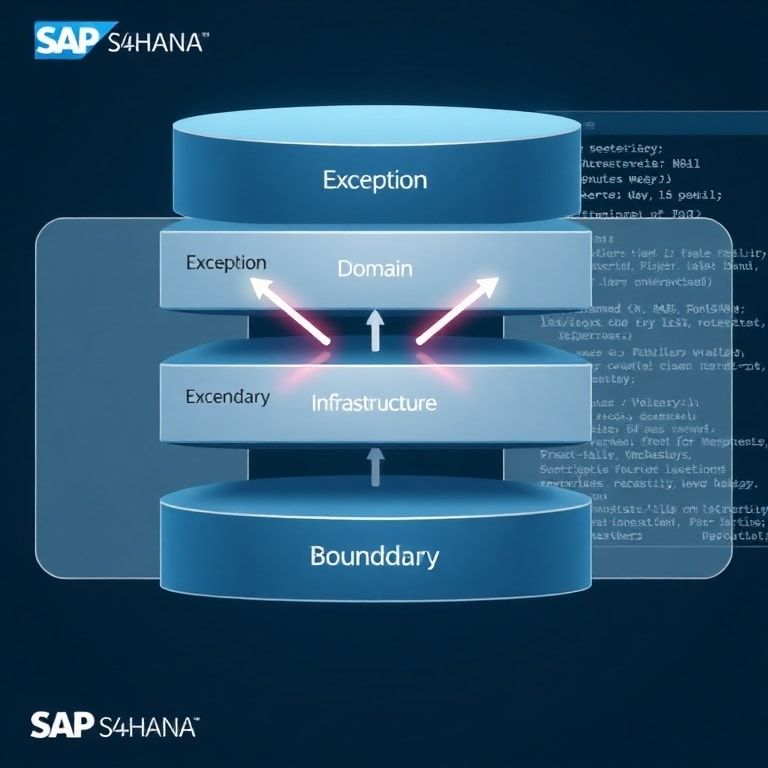
None of these approaches serve real enterprise systems. What you need instead is a layered strategy: exceptions are defined precisely, propagated deliberately, logged consistently, and presented meaningfully to each consumer of your code—whether that’s a Fiori app, a background job scheduler, or an external API caller.
The ABAP Exception Hierarchy: Know What You’re Working With
Before building anything, you need a firm grasp of the four exception categories in modern ABAP:
1. Class-Based Exceptions (the right tool)
Introduced with ABAP Objects, class-based exceptions are the standard for any clean, modern ABAP development. They inherit from CX_ROOT and its three subtypes:
CX_STATIC_CHECK— must be declared in the method signature; forces callers to handle them.CX_DYNAMIC_CHECK— checked at runtime only; not required in the signature.CX_NO_CHECK— never declared in signatures; reserved for truly unexpected system-level errors.
2. Classic Exceptions (legacy)
Used in function modules and classic ABAP. You’ll still encounter them everywhere in standard SAP code. You need to handle them, but you should not create new ones in S/4HANA development.
Architecture Rule #1
All new ABAP OOP code must use class-based exceptions. Classic exceptions are handled at the boundary layer when calling legacy function modules and immediately converted to class-based exceptions before propagation upward.
Designing Your Exception Class Hierarchy
One of the highest-leverage decisions you’ll make is designing your application’s own exception class hierarchy. Don’t just catch CX_ROOT and call it a day.
Here’s a pattern I recommend for domain-driven ABAP applications:
" Base application exception
CLASS zcx_app_base DEFINITION
  INHERITING FROM cx_static_check
  PUBLIC.

  PUBLIC SECTION.
    METHODS constructor
      IMPORTING
        textid   LIKE textid OPTIONAL
        previous LIKE previous OPTIONAL
        mv_context TYPE string OPTIONAL.
    DATA mv_context TYPE string READ-ONLY.
ENDCLASS.

" Domain-specific exceptions
CLASS zcx_sales_order_error DEFINITION
  INHERITING FROM zcx_app_base
  PUBLIC.

  PUBLIC SECTION.
    CONSTANTS:
      order_not_found TYPE sotr_conc VALUE 'ZCX_SALES_ORDER_ERROR_001',
      invalid_quantity TYPE sotr_conc VALUE 'ZCX_SALES_ORDER_ERROR_002'.
ENDCLASS.

" Infrastructure exceptions (DB, RFC, HTTP)
CLASS zcx_infrastructure_error DEFINITION
  INHERITING FROM zcx_app_base
  PUBLIC.
ENDCLASS.
This three-tier structure gives you enormous flexibility. Domain exceptions carry business meaning. Infrastructure exceptions carry technical detail. Your base class carries contextual metadata. Callers can catch at whatever granularity they need.
The Boundary Layer Pattern: Wrapping Legacy Calls
In real S/4HANA projects, you’ll spend a lot of time calling classic function modules. Here’s a pattern for wrapping them cleanly so your OOP layer stays pure:
METHOD get_customer_data.
  " Prerequisites: Valid customer number passed in iv_kunnr
  " Returns: Customer data structure
  " Raises: zcx_infrastructure_error on function module failure

  DATA: ls_kna1 TYPE kna1.

  CALL FUNCTION 'SD_CUSTOMER_MAINTAIN_ALL'
    EXPORTING
      kunnr = iv_kunnr
    IMPORTING
      kna1  = ls_kna1
    EXCEPTIONS
      not_found        = 1
      invalid_input    = 2
      OTHERS           = 3.

  CASE sy-subrc.
    WHEN 0.
      rv_customer = ls_kna1.
    WHEN 1.
      RAISE EXCEPTION TYPE zcx_infrastructure_error
        EXPORTING
          mv_context = |Customer { iv_kunnr } not found in KNA1|.
    WHEN OTHERS.
      RAISE EXCEPTION TYPE zcx_infrastructure_error
        EXPORTING
          mv_context = |Unexpected error calling SD_CUSTOMER_MAINTAIN_ALL, subrc: { sy-subrc }|.
  ENDCASE.

ENDMETHOD.
Notice what’s happening here: we enter legacy territory, we handle every possible legacy exception case explicitly, and we exit with a clean class-based exception. The calling layer above never needs to know a function module was involved. This is the boundary layer pattern in action.
Building a Centralized Application Log Integration
Catching exceptions is only half the job. The other half is making sure the right information gets to the right place. In S/4HANA, the Application Log (object SLG1) is your best friend for persistent, structured error logging in background processing and batch jobs.
Here’s a simple logging service class you can drop into most projects:
CLASS zcl_app_logger DEFINITION PUBLIC FINAL CREATE PRIVATE.

  PUBLIC SECTION.
    CLASS-METHODS get_instance
      RETURNING VALUE(ro_instance) TYPE REF TO zcl_app_logger.

    METHODS log_exception
      IMPORTING
        ix_exception TYPE REF TO cx_root
        iv_object    TYPE balobj_d
        iv_subobject TYPE balsubobj.

    METHODS save_log.

  PRIVATE SECTION.
    CLASS-DATA go_instance TYPE REF TO zcl_app_logger.
    DATA mv_log_handle TYPE balloghndl.

    METHODS constructor.

ENDCLASS.

CLASS zcl_app_logger IMPLEMENTATION.

  METHOD constructor.
    DATA: ls_log_header TYPE bal_s_log.
    ls_log_header-object    = 'ZAPPLICATION'.
    ls_log_header-subobject = 'ZGENERAL'.
    ls_log_header-aluser    = sy-uname.
    ls_log_header-aldate    = sy-datum.
    ls_log_header-altime    = sy-uzeit.

    CALL FUNCTION 'BAL_LOG_CREATE'
      EXPORTING
        i_s_log      = ls_log_header
      IMPORTING
        e_log_handle = mv_log_handle
      EXCEPTIONS
        OTHERS       = 1.
  ENDMETHOD.

  METHOD get_instance.
    IF go_instance IS NOT BOUND.
      go_instance = NEW #( ).
    ENDIF.
    ro_instance = go_instance.
  ENDMETHOD.

  METHOD log_exception.
    DATA: ls_msg TYPE bal_s_msg.

    ls_msg-msgty = 'E'.
    ls_msg-msgid = 'ZZ'.
    ls_msg-msgno = '001'.
    ls_msg-msgv1 = ix_exception->get_text( ).

    " Log exception chain — captures PREVIOUS exception context too
    DATA(lx_prev) = ix_exception->previous.
    IF lx_prev IS BOUND.
      ls_msg-msgv2 = lx_prev->get_text( ).
    ENDIF.

    CALL FUNCTION 'BAL_LOG_MSG_ADD'
      EXPORTING
        i_log_handle = mv_log_handle
        i_s_msg      = ls_msg
      EXCEPTIONS
        OTHERS       = 1.
  ENDMETHOD.

  METHOD save_log.
    CALL FUNCTION 'BAL_DB_SAVE'
      EXPORTING
        i_log_handle = mv_log_handle
      EXCEPTIONS
        OTHERS       = 1.
  ENDMETHOD.

ENDCLASS.
The key design choice here: this logger is a singleton within a single application session. You instantiate it once, log throughout your process, and save at the end. This minimizes database writes and gives you a single coherent log for each execution context.
Exception Chaining: Preserving Context Across Layers
One of the most overlooked features of ABAP class-based exceptions is the PREVIOUS parameter. This allows you to chain exceptions—wrapping a lower-level exception inside a higher-level one without losing the original diagnostic information.
METHOD process_sales_order.
  TRY.
      " This calls our infrastructure layer
      DATA(ls_customer) = get_customer_data( iv_kunnr = iv_kunnr ).

  CATCH zcx_infrastructure_error INTO DATA(lx_infra).
    " Wrap infrastructure error in domain-level exception
    " PREVIOUS preserves the full original stack context
    RAISE EXCEPTION TYPE zcx_sales_order_error
      EXPORTING
        textid   = zcx_sales_order_error=>order_not_found
        previous = lx_infra
        mv_context = |Order processing failed for customer { iv_kunnr }|.
  ENDTRY.
ENDMETHOD.
When this exception surfaces at the top level and you call get_previous( ), you can walk the entire chain. Your logging service can do exactly that—walk the chain and record every layer. This is invaluable when a support engineer is trying to trace what broke at 2am on a Saturday.
Handling Exceptions in RAP Business Objects
If you’re building applications with the ABAP RESTful Application Programming Model, exception handling has some specific considerations. In RAP, your behavior implementation methods use the FAILED, REPORTED, and MAPPED return structures rather than raising exceptions to the caller directly. However, internally, you absolutely should use class-based exceptions and convert them at the action/validation boundary.
METHOD validateOrderQuantity.
  TRY.
      DATA(lo_validator) = NEW zcl_order_quantity_validator( ).
      lo_validator->validate(
        iv_quantity = ls_order-quantity
        iv_uom      = ls_order-unit_of_measure
      ).

  CATCH zcx_sales_order_error INTO DATA(lx_error).
    " Convert exception to RAP reported structure
    APPEND VALUE #(
      %tky        = ls_order-%tky
      %state_area = 'VALIDATE_QTY'
      %msg        = NEW zcl_rap_message_adapter( lx_error )
      %element-quantity = if_abap_behv=>mk-on
    ) TO reported-salesorder.

    APPEND VALUE #( %tky = ls_order-%tky ) TO failed-salesorder.
  ENDTRY.
ENDMETHOD.
For a complete picture of building these RAP applications, see ABAP RESTful Application Programming Model (RAP): A Senior Architect’s Guide to Building Modern Fiori Apps—the RAP exception-to-message conversion pattern discussed there pairs directly with what we’ve covered here.
Testing Your Exception Handling: It Has to Be Tested
Here’s something most teams skip: testing the unhappy path. Your ABAP unit tests should explicitly cover exception scenarios.
METHOD test_customer_not_found_raises.
  " Arrange: inject a mock that simulates missing customer
  DATA(lo_mock_repo) = CAST zif_customer_repository(
    cl_abap_testdouble=>create( 'zif_customer_repository' )
  ).

  cl_abap_testdouble=>configure_call( lo_mock_repo
    )->raising( NEW zcx_infrastructure_error(
        mv_context = 'Test: customer not found' ) ).

  lo_mock_repo->get_by_id( iv_id = 'CUST001' ).

  " Act & Assert
  DATA(lo_service) = NEW zcl_order_service( io_repo = lo_mock_repo ).

  TRY.
      lo_service->process_order( iv_kunnr = 'CUST001' ).
      cl_abap_unit_assert=>fail( 'Expected exception was not raised' ).

  CATCH zcx_sales_order_error INTO DATA(lx_error).
    cl_abap_unit_assert=>assert_not_initial(
      act = lx_error->previous
      msg = 'Exception chain must preserve previous'
    ).
  ENDTRY.
ENDMETHOD.
For a broader treatment of ABAP unit testing strategies, including test doubles and mock injection patterns, check out ABAP Unit Testing in SAP S/4HANA: A Senior Architect’s Guide to Writing Tests That Actually Matter. The exception testing pattern here integrates directly with the dependency injection approach covered there.
Practical Checklist: Exception Handling Architecture Review
Before signing off on any SAP application going to production, I walk through this checklist:
- ✅ Custom exception class hierarchy defined, domain and infrastructure exceptions separated
- ✅ No bare
CATCH cx_rootblocks without meaningful logging and re-raise decisions - ✅ All legacy function module calls wrapped at boundary layer methods
- ✅ Exception chaining (
PREVIOUS) used consistently across layers - ✅ Application Log (SLG1) integrated for all background and batch processing
- ✅ RAP actions and validations convert exceptions to structured REPORTED messages
- ✅ Unit tests explicitly cover exception scenarios with mock injection
- ✅ No
RESUMEafterRETRYused without idempotency guarantee
Conclusion: Exception Handling Is a First-Class Design Concern
The goal of everything we’ve covered here is a system where failures are informative, recoverable, and traceable. When something goes wrong in production—and it will—your team should be able to open SLG1, find the full exception chain, understand exactly what broke and why, and get to a fix in minutes rather than hours.
That doesn’t happen by accident. It happens because someone made the architectural decision upfront to treat exception handling as a first-class citizen in the design—not as an afterthought bolted on before go-live.
Start with your exception hierarchy. Define your boundary layer pattern. Connect your logging service. Test your unhappy paths. The investment pays for itself the first time something breaks gracefully in production instead of dumping to SM21.
What patterns have you found most useful for ABAP exception handling in large-scale S/4HANA projects? Drop your thoughts in the comments—I’d genuinely like to hear what’s working in your systems.