ABAP Exception Handling Deep Dive: Building a Resilient, Class-Based Error Architecture in SAP S/4HANA
If there’s one thing I’ve learned after years of reviewing SAP codebases — from classic R/3 systems to modern S/4HANA landscapes — it’s this: exception handling is where code quality either holds firm or completely falls apart. Most ABAP developers know the syntax. Far fewer understand the architecture behind it. In this deep dive, we’re going beyond the basics of ABAP class-based exception handling to explore how you design a resilient, maintainable, and operationally transparent error architecture that actually serves your application in production.
This article is the natural progression from foundational concepts. If you’ve already studied clean ABAP fundamentals, you’ll know that writing readable and maintainable SAP code starts with how you handle failures. Let’s take that seriously.
Why Exception Handling Is an Architectural Concern, Not Just a Syntax Choice
Here’s the uncomfortable truth: most ABAP exception handling I encounter in real projects is defensive boilerplate. Developers wrap method calls in TRY...CATCH blocks, write the exception class name once, and then either log it silently or re-raise it blindly. That’s not error handling — that’s error burying.
Proper exception architecture answers three fundamental questions:
- What went wrong? — The exception carries semantic meaning, not just a message string.
- Who is responsible for handling it? — The call stack has layers; each layer has a defined responsibility.
- What should the system do next? — Recovery, compensation, or graceful degradation must be explicitly designed.
When you approach exceptions as an architectural concern, your system becomes predictable. Operators understand failure modes. Code reviewers can reason about error flows. And most importantly, your users don’t see cryptic dumps on a Monday morning.
The Three Types of Exceptions in ABAP — and When to Use Each
ABAP supports three exception mechanisms. Choosing the right one is the first architectural decision.
1. Classic Exceptions (Non-Class-Based)
You’ll still find these in function modules and older APIs. They use the EXCEPTIONS parameter in method/function calls and return numeric values. Avoid introducing these in any new development. They don’t carry structured data, they’re easy to ignore, and they don’t integrate with modern OOP patterns.
2. Class-Based Exceptions (CX_* Hierarchy)
This is the gold standard for modern ABAP development. Every exception is an object — an instance of a class that inherits from one of three root classes:
CX_STATIC_CHECK— Must be declared in the method signature. Forces callers to be aware of the exception at compile time. Use for expected, recoverable errors.CX_DYNAMIC_CHECK— Doesn’t have to be declared, but can be. Use for programming errors or precondition violations (think: invalid input that should have been validated upstream).CX_NO_CHECK— Never needs to be declared. Use for severe, typically unrecoverable system errors. Be careful here — overuse leads to invisible failure paths.
3. Runtime Errors (Short Dumps)
These are ABAP’s equivalent of unhandled kernel panics. You don’t handle them in application code — you prevent them. Always validate data before operations that could trigger dumps (division by zero, invalid casts, etc.).
Designing Your Exception Class Hierarchy
One of the most impactful things you can do for a large SAP module is design a domain-specific exception hierarchy. This is where architecture separates itself from ad hoc coding.
Here’s a pattern I’ve used successfully in several S/4HANA implementations:
" Root exception for your application domain
CLASS zcx_mm_exception DEFINITION
  INHERITING FROM cx_static_check
  PUBLIC.

  PUBLIC SECTION.
    METHODS constructor
      IMPORTING
        textid   LIKE if_t100_message=>t100key OPTIONAL
        previous LIKE previous OPTIONAL
        mv_detail TYPE string OPTIONAL.

    DATA mv_detail TYPE string READ-ONLY.

ENDCLASS.

" Specialized exception for business rule violations
CLASS zcx_mm_business_rule_violation DEFINITION
  INHERITING FROM zcx_mm_exception
  PUBLIC.

  PUBLIC SECTION.
    CONSTANTS:
      gc_stock_below_minimum TYPE sotr_conc VALUE '...',  " T100 message key
      gc_invalid_plant       TYPE sotr_conc VALUE '...'.

ENDCLASS.

" Specialized exception for data integrity issues
CLASS zcx_mm_data_integrity_error DEFINITION
  INHERITING FROM zcx_mm_exception
  PUBLIC.
ENDCLASS.
Notice the pattern: one root domain exception, then specialized children for different failure categories. This gives you flexibility in catching — you can catch the root type to handle all domain errors generically, or catch specific children when you need targeted recovery logic.
Key design rules for your hierarchy:
- Never create a single catch-all exception class for an entire system. Granularity matters.
- Use T100 message keys for user-facing messages — it supports translation and keeps text maintenance outside the code.
- Always carry context data in the exception object itself (not just a string message).
- The
previousparameter is your best friend — it chains exceptions to preserve the original cause.
Layered Exception Handling: Who Catches What, and Where
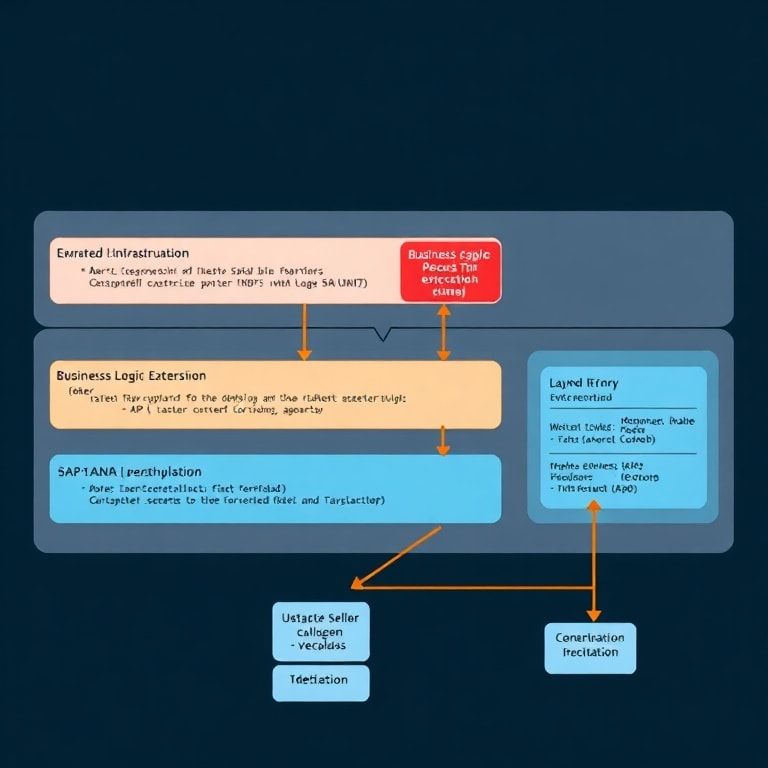
This is the concept most developers skip, and it’s what separates resilient systems from fragile ones. Think of your application in layers:
Layer 1: Infrastructure / Data Access
At this level (database reads, RFC calls, file I/O), you catch low-level system exceptions and wrap them into domain exceptions. You translate technical failures into something semantically meaningful for your business layer.
METHOD read_material_data.
  TRY.
      " Database access or RFC call
      SELECT SINGLE * FROM mara INTO @DATA(ls_material)
        WHERE matnr = @iv_matnr.

      IF sy-subrc <> 0.
        RAISE EXCEPTION TYPE zcx_mm_data_integrity_error
          EXPORTING
            mv_detail = |Material { iv_matnr } not found in MARA|.
      ENDIF.

  CATCH cx_sy_open_sql_error INTO DATA(lx_sql).
      " Wrap infrastructure error in domain exception, preserve cause
      RAISE EXCEPTION TYPE zcx_mm_data_integrity_error
        EXPORTING
          previous  = lx_sql
          mv_detail = |SQL error reading material { iv_matnr }|.
  ENDTRY.
ENDMETHOD.
Layer 2: Business Logic / Service Layer
Here you handle recoverable errors — apply fallback logic, attempt compensation, or enrich the exception with more business context before propagating upward.
METHOD process_goods_movement.
  TRY.
      DATA(lo_material) = read_material_data( iv_matnr ).
      validate_stock_levels( lo_material ).
      post_movement( lo_material ).

  CATCH zcx_mm_business_rule_violation INTO DATA(lx_rule).
      " Business rule violation — log and propagate with context
      log_application_error(
        iv_message  = lx_rule->get_text( )
        iv_detail   = lx_rule->mv_detail
        iv_severity = gc_warning
      ).
      " Re-raise to let the UI layer decide how to present this
      RAISE EXCEPTION lx_rule.

  CATCH zcx_mm_data_integrity_error INTO DATA(lx_data).
      " Data error — this needs immediate attention, escalate
      log_application_error(
        iv_message  = lx_data->get_text( )
        iv_severity = gc_error
      ).
      RAISE EXCEPTION lx_data.
  ENDTRY.
ENDMETHOD.
Layer 3: UI / Controller Layer (Fiori / RAP Handler)
This is the outermost boundary. Here you translate exceptions into user-facing messages using the IF_ABAP_BEHV_MESSAGE interface (in RAP) or message classes in classic Dynpro/Fiori scenarios. No exception should ever bubble past this layer unhandled.
" In a RAP action implementation
METHOD execute_goods_movement.
  TRY.
      lo_service->process_goods_movement(
        EXPORTING iv_matnr = ls_key-matnr
      ).

  CATCH zcx_mm_business_rule_violation INTO DATA(lx_business).
      APPEND VALUE #(
        %key      = ls_key
        %msg      = new_message(
                      id       = 'ZMM_MESSAGES'
                      number   = '001'
                      severity = if_abap_behv_message=>severity-error
                      v1       = lx_business->mv_detail
                    )
        %element  = VALUE #( matnr = if_abap_behv=>mk-on )
      ) TO reported-zc_goods_movement.

  CATCH zcx_mm_exception INTO DATA(lx_general).
      " Fallback for any other domain exception
      APPEND VALUE #(
        %key  = ls_key
        %msg  = new_message_from_exception( lx_general )
      ) TO reported-zc_goods_movement.
  ENDTRY.
ENDMETHOD.
Exception Chaining: Never Lose the Root Cause
One of the most underused features in ABAP exception handling is the previous attribute inherited from CX_ROOT. When you catch an exception and raise a new one, always chain them.
CATCH cx_some_system_error INTO DATA(lx_system).
  RAISE EXCEPTION TYPE zcx_mm_data_integrity_error
    EXPORTING
      previous  = lx_system  " <-- Chain here
      mv_detail = 'Context-specific message'.
This builds an exception chain you can traverse when debugging or logging. A helper method to walk the chain is invaluable:
METHOD get_full_exception_chain.
  DATA(lx_current) = io_exception.
  DO.
    IF lx_current IS NOT BOUND.
      EXIT.
    ENDIF.
    APPEND lx_current->get_text( ) TO rt_messages.
    lx_current = lx_current->previous.
  ENDDO.
ENDMETHOD.
Application Logging: The Operational Dimension
Error handling and logging are complementary but distinct concerns. Your exception classes carry structured error data; your logging infrastructure decides how to persist and surface that data. In modern S/4HANA, use the CL_BALI_LOG API (Business Application Log Interface) for structured, query-able logs.
METHOD log_domain_exception.
  DATA(lo_log)   = cl_bali_log=>create( ).
  DATA(lo_item)  = cl_bali_exception_setter=>create(
                    severity  = if_bali_constants=>c_severity_error
                    exception = io_exception
                  ).
  lo_log->add_item( lo_item ).
  cl_bali_log_db=>get_instance( )->save_log( lo_log ).
ENDMETHOD.
The BALI framework gives you logs that are searchable via transaction SLG1, filterable by object and sub-object, and viewable in Fiori apps — a significant improvement over old-school CALL FUNCTION 'BAL_LOG_CREATE' approaches.
Common Anti-Patterns to Eliminate Today
Before closing, let me call out the patterns I want you to remove from your codebase:
- Empty CATCH blocks — Catching an exception and doing nothing is worse than not catching it. It hides failures silently.
- Catching CX_ROOT everywhere — This catches everything, including things you shouldn’t be handling. Catch the most specific type possible.
- Using SY-SUBRC checks instead of exceptions in new OOP code — Pick one paradigm and stick to it. SY-SUBRC is for function modules and compatibility scenarios.
- Putting user message text directly in exception constructors — Use T100 message keys. Your future translator will thank you.
- Re-raising with RAISE EXCEPTION TYPE instead of RAISE EXCEPTION lx_obj when you already have an instance — The former creates a new object and discards the call stack context of the original exception.
Practical Checklist: Exception Architecture Review
Use this when reviewing your own code or doing a code review for your team:
- ☐ Is there a domain-specific root exception class?
- ☐ Are exception classes organized in a meaningful hierarchy?
- ☐ Do exceptions carry structured context data (not just message strings)?
- ☐ Is exception chaining (
previous) used when wrapping? - ☐ Are T100 message keys used for user-facing text?
- ☐ Is each architectural layer catching only what it can meaningfully handle?
- ☐ Are logs written with BALI or an equivalent structured framework?
- ☐ Are there any empty CATCH blocks? (If yes, fix immediately)
- ☐ Does the UI layer always have a final safety net catch?
Conclusion: Exceptions Are Documentation
Here’s a mindset shift I find genuinely useful: treat your exception classes as part of your system’s documentation. They declare, explicitly and in code, what can go wrong. A well-designed exception hierarchy tells you more about a system’s failure modes than any wiki page ever will — and unlike wiki pages, exception classes can’t go stale if you keep them maintained.
The investment in a solid exception architecture pays back every time you debug a production issue in minutes rather than hours, every time a junior developer understands exactly what a method might throw without reading its entire body, and every time an operator can filter SLG1 logs by a specific error category to understand a business process failure.
If you want to go deeper on related topics, the principles here connect directly to writing ABAP unit tests that actually matter — because testable code and well-structured exception handling go hand in hand. And if you’re building Fiori applications with RAP, the exception handling patterns in this article integrate directly with the RAP architecture for modern SAP Fiori apps.
What’s your experience with exception architecture in large SAP systems? Have you inherited a codebase where exceptions were being swallowed silently? I’d genuinely love to hear how you approached the refactoring. Drop a comment below or reach out — these are the conversations that actually move our community forward.